Real-Time Chemical Analysis: AI and LIBS Impact
Real-Time Chemical Analysis: The Impact of AI and LIBS
Introduction
In modern industries, speed and accuracy in material analysis have become essential to ensure performance and competitiveness. However, traditional laboratory-based methods are often slow, costly, and not adapted to real-time decision-making.
Today, the combination of Laser-Induced Breakdown Spectroscopy and artificial intelligence is transforming chemical analysis by enabling reliable, real-time results directly in the field.
Limitations of Traditional Analysis Methods
Although laboratory analyses are highly accurate, they present several major constraints:
- ⏳ Long turnaround times
- 💰 High operational costs
- 📦 Sample transportation and preparation
- ❌ Lack of responsiveness
In industries such as mining and agriculture, these limitations can delay decision-making and negatively impact overall performance.
Real-Time Analysis as a Strategic Advantage
Real-time analysis allows companies to access immediate and reliable insights into material composition.
Key benefits:
- Instant decision-making
- Process optimization
- Reduced material losses
- Increased productivity
As a result, analysis becomes a core operational tool rather than a delayed support function.
The Key Role of Artificial Intelligence
One of the main challenges of LIBS technology lies in interpreting complex spectral data, especially when dealing with heterogeneous materials.
Artificial intelligence enables:
- Advanced interpretation of complex spectral data
- Compensation for material variability
- Improved analytical accuracy
- Reduction of interpretation errors
Reagent-Free Analysis in a Single Measurement
One of the key advantages of advanced LIBS-based solutions is their ability to perform quantitative chemical analysis of all elements — including trace elements — in a single measurement, without the use of reagents.
This “reagent-free” approach significantly simplifies the analytical process while reducing costs and accelerating operations, both in the field and in laboratory environments.
LIBS + AI: Laboratory-Grade Accuracy
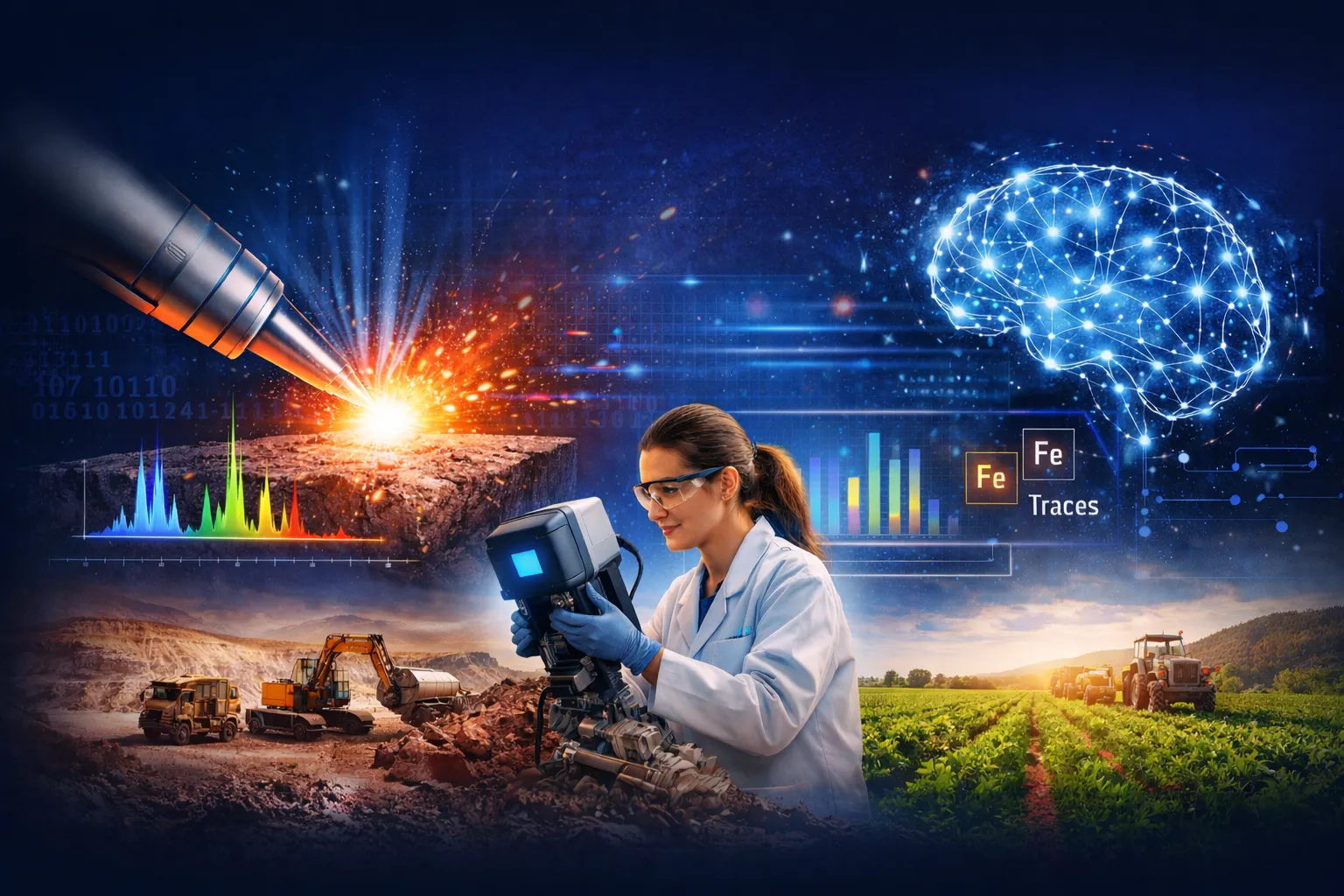
Photons Analysis combines high-frequency laser ablation with proprietary machine learning models to enhance the accuracy of chemical analysis, particularly for complex and non-uniform materials.
Thanks to this approach, the company delivers real-time chemical analysis with accuracy comparable to traditional laboratory methods.
According to the information provided, the deviation from standard lab methods is less than 2%, while enabling detection from major elements down to trace-level concentrations.
Industrial Applications
Mining
Real-time ore grade analysis to optimize extraction and reduce losses.
Agriculture
Precise soil mapping to improve crop yield and resource management.
Chemical Industry
Non-contact analysis of complex and corrosive liquids for quality control.
Direct Impact on Business Performance
Combining real-time analysis with artificial intelligence allows companies to:
- Reduce operational costs
- Improve decision accuracy
- Accelerate industrial processes
- Minimize risks and errors
This technology becomes a key driver of industrial performance.
Why Adopt These Technologies Now
In an increasingly competitive environment, companies must rely on tools that provide fast and reliable data.
Adopting technologies such as LIBS combined with AI enables organizations to:
- Increase efficiency
- Improve analytical quality
- Make data-driven decisions in real time
Conclusion
The integration of artificial intelligence into LIBS technology represents a major breakthrough in chemical analysis. By combining speed, precision, and adaptability, it meets the demands of modern industries.
It enables the transition from slow, centralized analysis to intelligent, real-time, and actionable insights directly in the field.
Looking to improve your analysis capabilities and accelerate decision-making?
Discover how LIBS and AI-powered solutions can transform your industrial operations.